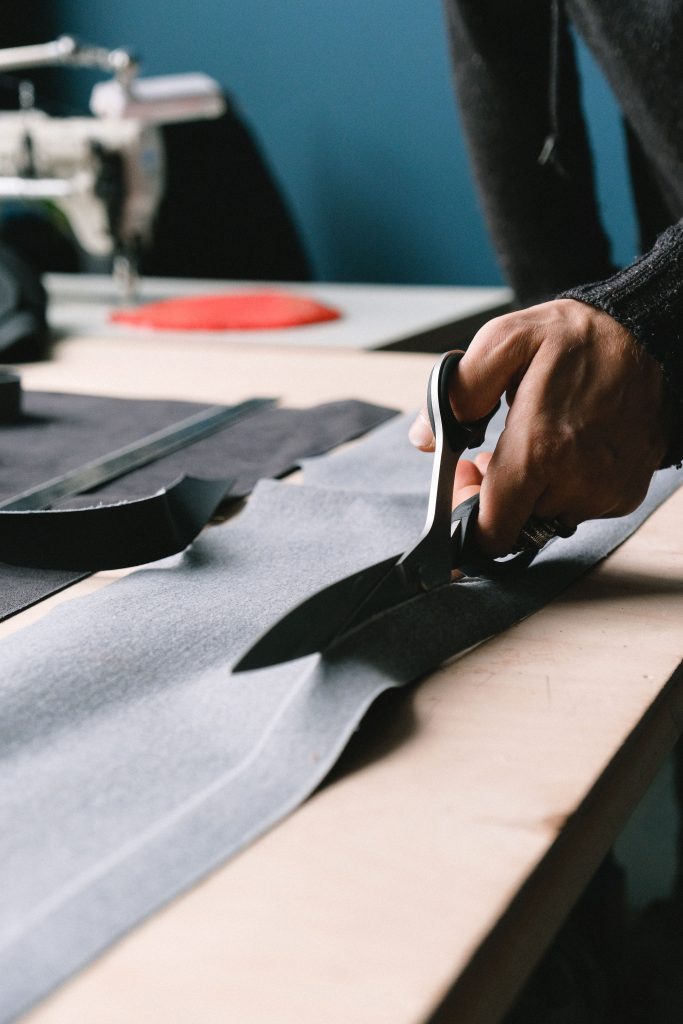
When people talk about buying a suit, three terms appear repeatedly:
Off-the-rack.
Made-to-measure.
Bespoke.
They are often used interchangeably.
They should not be.
The three approaches represent genuinely different ways of making clothing. They involve different levels of personalisation, different approaches to pattern cutting, different fitting processes and, usually, different price points.
The right choice depends on what you need from the garment.
Someone looking for a suit for an urgent event may reasonably choose off-the-rack.
Someone building a professional wardrobe may prefer made-to-measure.
Someone commissioning a wedding suit or a core wardrobe piece may decide that bespoke tailoring offers the level of personalisation they want.
Understanding the difference helps you spend your money intelligently.
The Difference at a Glance
| Feature | Off-the-Rack | Made-to-Measure | Bespoke |
|---|---|---|---|
| Pattern | Standard shared pattern | Existing pattern adjusted | Unique pattern drafted for client |
| Measurements | Standard size chart | Individual measurements | Individual measurements and posture |
| Personalisation | Limited | Moderate to high | Highest |
| Fittings | Usually none or alterations | Usually one or more | Multiple fittings |
| Fit | Approximate | Improved | Highly individualised |
| Turnaround | Fastest | Moderate | Longest |
| Price | Lowest | Mid-range | Highest |
| Best For | Speed and budget | Better fit and flexibility | Maximum personalisation |
The most important distinction is the pattern.
The pattern determines the shape of the garment.
And the way that pattern is created fundamentally affects how individually the garment can be fitted.
What Is Off-the-Rack Tailoring?
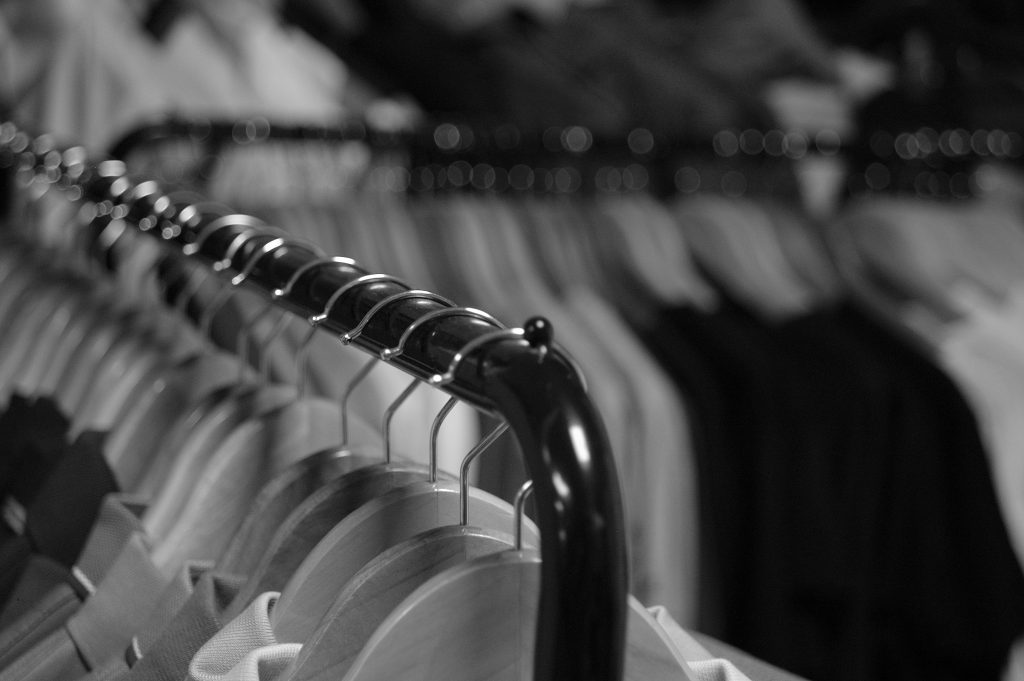
Off-the-rack clothing is manufactured in standard sizes.
A brand may produce a range of jackets in sizes such as:
- 38
- 40
- 42
- 44
These sizes are based on standardised measurements.
The advantage is convenience.
You can walk into a shop, select a size, try it on and potentially leave with the garment immediately.
The trade-off is that the garment was not designed specifically for your proportions.
Your chest may fit perfectly while the sleeves are too long.
The shoulders may fit while the waist is too loose.
The trousers may fit at the waist while the length requires adjustment.
This is not necessarily a failure of the garment.
It is the natural limitation of standard sizing.
Standard clothing is designed to fit a range of bodies.
It is not designed specifically for yours.
The Advantages of Off-the-Rack
Off-the-rack suits offer:
- Speed
- Lower initial cost
- Immediate availability
- Wide accessibility
- A broad range of styles
They can also be improved through alterations.
A skilled alterations tailor can shorten sleeves, adjust trousers and refine certain areas of the garment.
However, alterations cannot completely transform every garment.
Some elements — particularly shoulder construction and the fundamental shape of the jacket — are difficult or impossible to change substantially after manufacturing.
What Is Made-to-Measure?
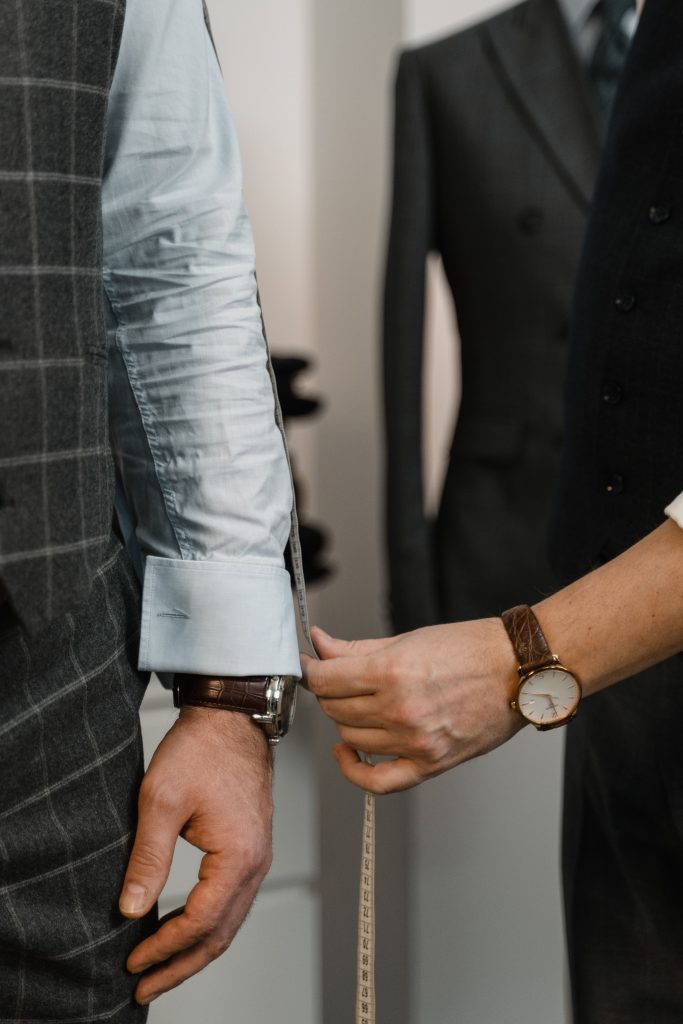
Made-to-measure occupies the middle ground between standard clothing and full bespoke tailoring.
The process usually begins with an existing pattern block.
That pattern is then adjusted using the client’s measurements.
The result is more personalised than an off-the-rack garment, while generally requiring less time and construction work than full bespoke tailoring.
Made-to-measure may allow the client to select:
- Fabric
- Colour
- Lapel style
- Buttons
- Trouser style
- Jacket details
- Certain fit preferences
The pattern, however, is still generally based on an existing template.
That is the key difference between made-to-measure and bespoke.
Who Is Made-to-Measure Suitable For?
Made-to-measure can be an excellent option for:
- First-time custom suit buyers
- Professionals who want better fit
- Clients with relatively standard proportions
- People building a wardrobe gradually
- Clients who want personalisation without the full bespoke process
A well-executed made-to-measure garment can fit exceptionally well.
The skill of the tailor still matters enormously.
A poorly adjusted template will produce a poor garment.
A skilled tailor can make intelligent adjustments that produce a significant improvement over standard sizing.
What Is Bespoke Tailoring?
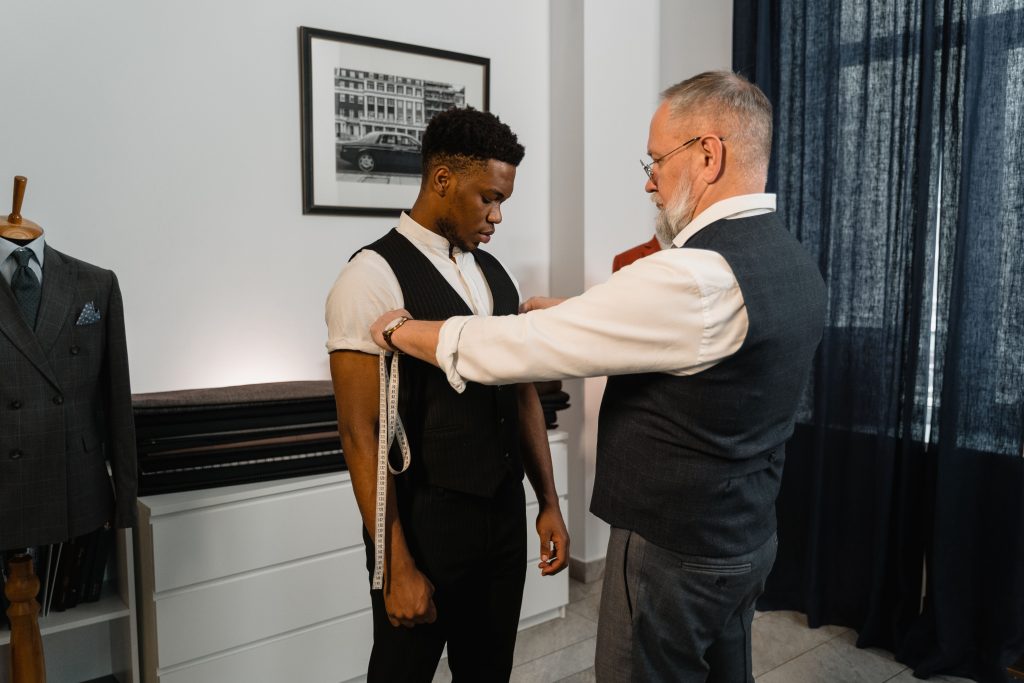
Bespoke tailoring begins with the individual client.
Measurements are taken.
Posture is observed.
Proportions are considered.
The pattern is drafted specifically for the client.
The garment is then constructed and refined through fittings.
The central idea is simple:
The garment is built around the individual rather than the individual being asked to fit an existing template.
A bespoke pattern may account for:
- Shoulder asymmetry
- Posture
- Forward lean
- Chest shape
- Waist-to-shoulder proportion
- Arm position
- Individual preference
- Movement requirements
This level of individualisation is particularly valuable for people whose bodies do not fit neatly into standard proportions.
It is also attractive to clients who want complete involvement in the design process.
Why Does the Fit Difference Matter?
Every human body is slightly asymmetrical.
One shoulder may sit marginally lower.
One arm may be slightly longer.
The back may curve differently from the standard pattern assumption.
The waist and hips may not follow standard proportions.
Standard sizing cannot account for all of these variations.
Made-to-measure can correct many of them.
Bespoke tailoring can address them at the pattern-drafting stage.
That is why a bespoke garment can appear noticeably different from a standard suit even when the two use similar fabrics and colours.
The difference is not always dramatic.
Sometimes it is simply that the jacket sits correctly.
The shoulder line is balanced.
The sleeve hangs naturally.
The trousers move with the body.
The wearer does not need to constantly adjust the garment.
That is often what good tailoring feels like.
Nothing is fighting you.
What About Construction?
The difference between bespoke and made-to-measure is not only about the pattern.
Construction also matters.
Depending on the tailor and garment, construction may involve:
- Fused interlinings
- Half-canvas construction
- Full-canvas construction
- Hand-finished buttonholes
- Hand stitching
- Structured internal construction
A bespoke garment does not automatically guarantee every possible hand-finishing technique.
The important thing is to understand what is actually being offered.
The word bespoke should describe a genuinely individualised process rather than simply being used as a premium marketing label.
Which Option Should You Choose?
Choose Off-the-Rack If:
You need a suit quickly.
You have a limited budget.
You only wear formal clothing occasionally.
You are comfortable with standard sizing and minor alterations.
Choose Made-to-Measure If:
You want a significantly better fit than standard clothing.
You want to select fabrics and design details.
You want a custom garment without the full bespoke timeline.
You are beginning to build a more intentional wardrobe.
Choose Bespoke If:
The garment has significant personal importance.
You want a pattern drafted specifically for your body.
You have unusual proportions that standard sizing struggles with.
You are commissioning a wedding suit.
You are building a core executive wardrobe.
You want maximum involvement in the design and fitting process.
Is Bespoke Always Better?
Not necessarily.
The word “better” depends on what you need.
A person who needs a suit tomorrow may be better served by an excellent off-the-rack suit with professional alterations than by a bespoke suit that cannot be completed in time.
A professional who wants a strong wardrobe foundation may find made-to-measure an excellent choice.
A groom who has months before a wedding may value the additional personalisation of bespoke tailoring.
The best choice is the one that matches:
- Your occasion
- Your timeline
- Your budget
- Your body
- Your frequency of wear
- Your expectations
Frequently Asked Questions
Is bespoke always better than made-to-measure?
No. Made-to-measure can offer excellent fit and personalisation. Bespoke offers a higher level of individual pattern development and fitting, but the additional investment makes most sense when the garment’s importance or frequency of wear justifies it.
Can made-to-measure achieve a near-bespoke fit?
Yes. A skilled tailor can make highly precise adjustments to an existing pattern. The difference becomes more significant when a client has unusual proportions or requires highly specific pattern changes.
Why does bespoke cost more?
Bespoke involves more individual labour. A unique pattern must be drafted, the garment requires more individual attention and multiple fittings may be required.
Which is best for a wedding suit?
Bespoke or high-quality made-to-measure can both be excellent choices. The decision depends on the desired level of personalisation, timeline and budget.
Which is best for an executive wardrobe?
Many professionals use a combination. Made-to-measure can provide an excellent foundation, while bespoke can be reserved for core pieces worn frequently.
The Right Suit Is the One Built for the Way You Live
There is no single correct way to buy clothing.
Off-the-rack offers speed.
Made-to-measure offers increased personalisation.
Bespoke offers the highest degree of individual pattern development and fitting.
At Aspire Africa Clothing, bespoke tailoring in Nairobi is available for clients who want their clothing built around their individual proportions, personal style and intended use — from wedding suits and tuxedos to executive wear and African formalwear.
The important thing is not simply to choose the most expensive option.
It is to choose the process that gives you the result you actually need.